Merge Announces New Customer, PivotCX, Powering 38 ATS Integrations

Merge Announces New Customer, PivotCX, Powering 38 ATS Integrations

Merge, the Unified API for B2B integrations, today announced that its ATS Unified API is powering integrations for PivotCX, a communications hub for talent acquisition. PivotCX now supports integrations with 38 popular Applicant Tracking Systems (ATS), including Workday and Taleo, using Merge’s ATS Unified API. PivotCX orchestrates conversations across communication channels such as text, voice, video, and email. The ATS integrations provided through the Merge Unified API enable PivotCX to dramatically increase recruiter productivity while also providing a streamlined candidate experience.

“We’re thrilled to see Unified APIs unlocking new integrations and customer experiences. PivotCX is making it easier for recruiters and candidates to coordinate, and hire people faster, using integrations with ATS tools,” said Shensi Ding, CEO and Co-Founder of Merge. “PivotCX’s support for 38 integrations at once is a testament to how Unified APIs make it easier than ever to offer customers all of the integrations they want.”

PivotCX selected Merge based on the breadth and depth of the platform’s ATS integration support. Mike Seidle, CTO and Co-Founder of PivotCX, observes that Merge “takes a very systematic approach to integrations with a Unified API. Merge creates a universal model for ATS data that greatly simplifies the work for my team.”

PivotCX has already seen market traction and new clients from the expanded ATS integration support. Mike Seidle observes that the “ability to load candidate data directly from ATS tools allows employers to start recruiting conversations immediately. ATS integrations just landed us a contract with the largest employer in our home state of Indiana.” PivotCX’s EVP Corp Dev & Strategy, David Bernstein, notes that expanding integration support with “a Unified API frees up our development team to focus on bringing on new customers, rather than building and maintaining integrations. Merge is a fundamental piece of our growth strategy.”

Continue Reading here: https://www.prnewswire.com/news-releases/merge-announces-new-customer-pivotcx-powering-38-ats-integrations-301621605.html

HR Tech Conference: PivotCX Nominated for Pitchfest 2022

HR Tech Conference: PivotCX Nominated for Pitchfest 2022

The HR Technology Conference & Exposition® is pleased to announce the participants of its 2022 Pitchfest. The popular startup competition will take place during the upcoming HR Technology Conference, happening September 13 – 16, 2022, at Mandalay Bay in Las Vegas.

This year, 33 companies will compete during the three preliminary rounds, each with five minutes to present and two to three minutes to answer questions from the judges. Based on a combination of votes from the audience and the judges, the total score earned by each company in the preliminary rounds will determine which six advance to the finals.

PivotCX is excited to be nominated in this list and excited to present at HR Tech in Las Vegas.

Read more here: https://www.globenewswire.com/en/news-release/2022/08/30/2506551/0/en/HR-Technology-Conference-Exposition-Announces-2022-Pitchfest-Participants.html

Pivot to First Episode 4: Ton Dobbe on Creating and Growing a Successful SaaS Company

Pivot to First Episode 4: Ton Dobbe on Creating and Growing a Successful SaaS Company

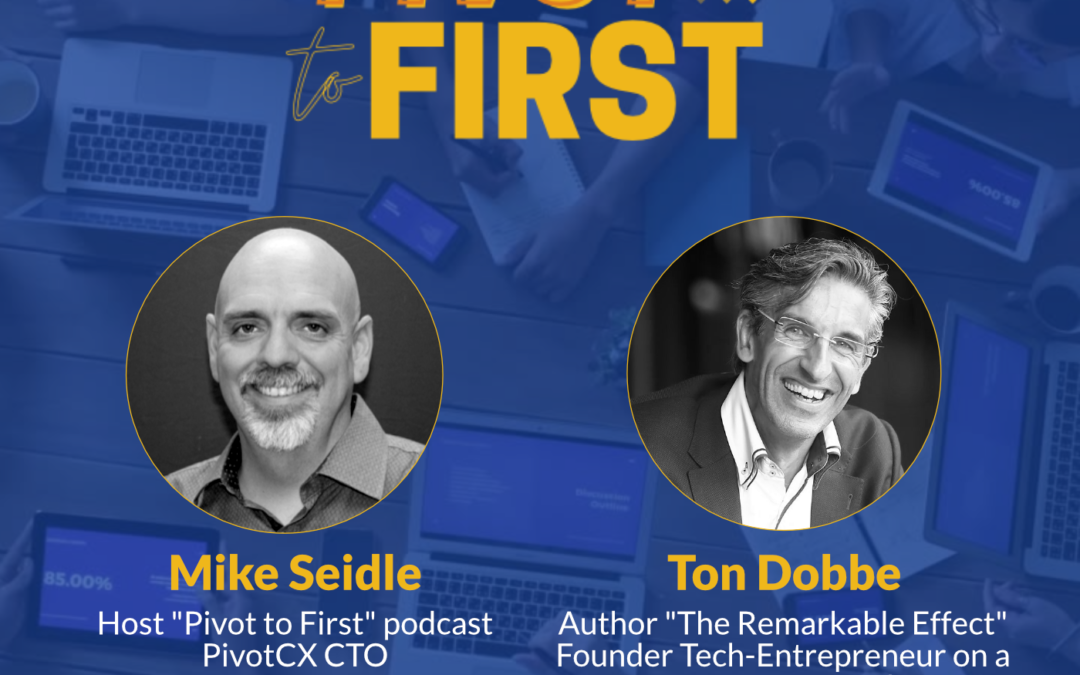
In addition to podcast hosting, Ton Dobbe is the author of The Remarkable Effect and a SaaS Strategy consultant. Mike appeared on Ton’s podcast Tech Entrepreneur on a Mission Season 4, Ep. 163 published 4/26/2021. This time around, Mike hosts Ton.

For Ton, starting his podcast goes hand in hand with establishing his own consultancy. He wanted to learn how to build a remarkable software business from successful entrepreneurs. His desire to learn from the best soon became a flow and after 60 -70 episodes someone encouraged him to write a book discussing and distilling all the wisdom enshrined in the podcast.

In this episode, Mike and Ton talk about:

What do entrepreneurs need to do to be one of those companies everyone keeps talking about? It’s all about assessing where you stand today and having a vision to guide your and your team’s actions.

How important is talent to grow a successful SaaS company? People and cultural fit a are part of the process. Different people are needed at different stages.

SaaS entrepreneurs have a lot on their plate and sometimes they don’t have a full picture, what are they getting wrong? Everybody makes bad hires, but how you deal with those issues makes all the difference. Also, not getting stuck in ideas and other types of silos can give companies a leg up.

When a company isn’t in an upshot, how do companies assess where they stand and figure out how to get on a growth path? According to some statistics, 9 out of 10 startups fail and 75% of scaleups fail. These figures make it imperative for companies to find the right market fit and positioning to sustain growth.

Finding the right talent for the right role at the right time, having a clear vision with buy-in from everyone involved, as well as adding value for your customers – solving their needs and problems – can lead a struggling or plateaued company to sustained success.

Pivot to First Podcast: Jo Dodds on Employee Engagement

Pivot to First Podcast: Jo Dodds on Employee Engagement

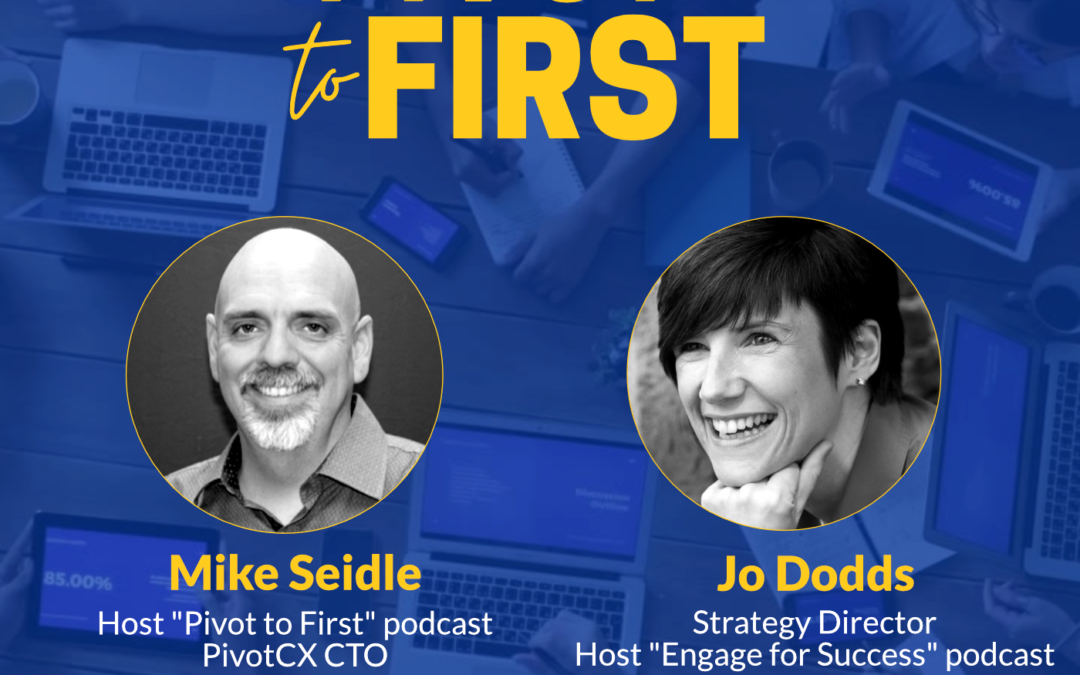
In this podcast episode, Mike chats with Jo Dodds, host of the podcast Engage for Success and a leader of the employee engagement movement.

Ever since the Engaging for Success was published in 2009, Jo has been at the forefront of advocating for best practices in employee engagement. Employee engagement and success have grown into an important cornerstone of a successful company. While hard to define, employee success can be considered as people need to have something meaningful about their work to do the best job they can. Employee experience is the next step forward.

With the Great Resignation, people are shuffling across companies but not everyone is finding that they’re getting what they signed up for. Companies lose good people because they are not talking to everyone. Start out with the supposition that ALL CANDIDATES are good people to talk with and you’ll do a much better job with recruiting.

Important to a successful employee engagement strategy is to focus on the 4 enablers:

1. Strategic Narrative – Visible, empowering leadership providing a strong strategic narrative about the organization, where it’s come from, and where it’s going

2. Engaging Managers – who focus on their people and give them scope, treat their people as individuals, and coach and stretch their people.

3. Employee Voice – Employees are seen not as the problem, but rather as central to the solution, to be involved, listened to, and invited to contribute their experience, expertise, and ideas.

4. Organizational Integrity – the values on the wall are reflected in day-to-day behaviors. There is no ‘say–do’ gap. Promises made and promises kept, or an explanation given as to why not.

Learn more about Jo Dodds and the Engage for Success movement here: https://engageforsuccess.org/ 


Workforce: Rethinking Talent Models

Workforce: Rethinking Talent Models

Originally published by

Deloitte Insights 

Not only have workforce demographics changed over the last 30 years—collectively making the workforce older and more diverse—but the very social contract between employers and employees has altered dramatically as well. Organizations now have a broad continuum of options for finding workers, from hiring traditional full-time employees to availing themselves of managed services and outsourcing, independent contractors, gig workers, and crowdsourcing. These newer workforce types are available to solve problems, get work done, and help leaders build more flexible and nimble organizations (figure 2). Alternative workers are growing in number; currently, 35 percent of the US workforce is in supplemental, temporary, project, or contract-based work. This percentage is growing as well—for example, the freelance workforce is growing faster than the total workforce, up 8.1 percent compared to 2.6 percent of all employees.

As labor-sourcing options increase, it opens up the possibility for more efficiency and creativity in composing an organization’s workforce. But with more options often comes more complexity. Employers should not only consider how roles are crafted when pairing humans with machines, but also the arrangement of their human workforce and what type(s) of employment are best suited to obtain the creativity, passion, and skill sets needed for the work at hand. Orchestrating this complex use of different workforce segments might require new models. It could fundamentally change our view of the employee life cycle from the traditional “attract, develop, and retain” model to one where the key questions are how organizations should access, curate, and engage workforces of all types (see the sidebar, “Beyond the employee life cycle”).

Organizations have an opportunity to optimize the organizational benefits of each type of talent relationship while also providing meaningful and engaging options for a wide variety of worker needs and motivations. However, making the most of the opportunity could require a complete rethinking of talent models in a way that allows organizations to carefully match people’s motivations and skills with the organization’s work needs.

Access. How do you tap into capabilities and skills across your enterprise and the broader ecosystem? This includes sourcing from internal and external talent marketplaces and leveraging and mobilizing on- and off-balance sheet talent.

Curate. How do you provide employees—ecosystem talent—and teams with the broadest and most meaningful range of development? This includes work experiences that are integrated into the flow of their work, careers, and personal lives.

Engage. How do you interact with and support your workforces, business teams, and partners to build compelling relationships? This includes multidirectional careers in, across, and outside of the enterprise; and for business leaders and teams, providing insights to improve productivity and impact while taking advantage of new ways of teaming and working.

Deloitte Consulting LLP – © 2021

Imagine being able to engage your applicants within five minutes of application, then engaged in human-to-human interaction starting in seconds. PivotCX can make this process happen. See our 90-second video explaining how PivotCX can help you get to the right talent fast so you can Pick First.